
This site uses cookies for analytics and to improve your experience. By clicking Accept, you consent to our use of cookies. Learn more in our privacy policy.
A 45 KVA generator will service a wedding of 120 people with an average power consumption requirement. It is vital you or your planner goes through each element of your event and totals up the power required to ensure you have a generator big enough.
Throughout this post we shall address each section your wedding event is likely to have and assign a relevant power consumption to give you an example of what a typical wedding marquee event will need. Alongside that we have created a downloadable tool for you to use and input your own power data, which will help you know what you need when you start looking into generator hire and the different sizes available.
Total Power – 39.624KW
Lets look at the above example in more detail to understand a bit more about where the power is going. You may end with more or less in each section but you should be checking each independently to make sure your figures add up correctly. After you have the total we can look at converting it to a generator size.
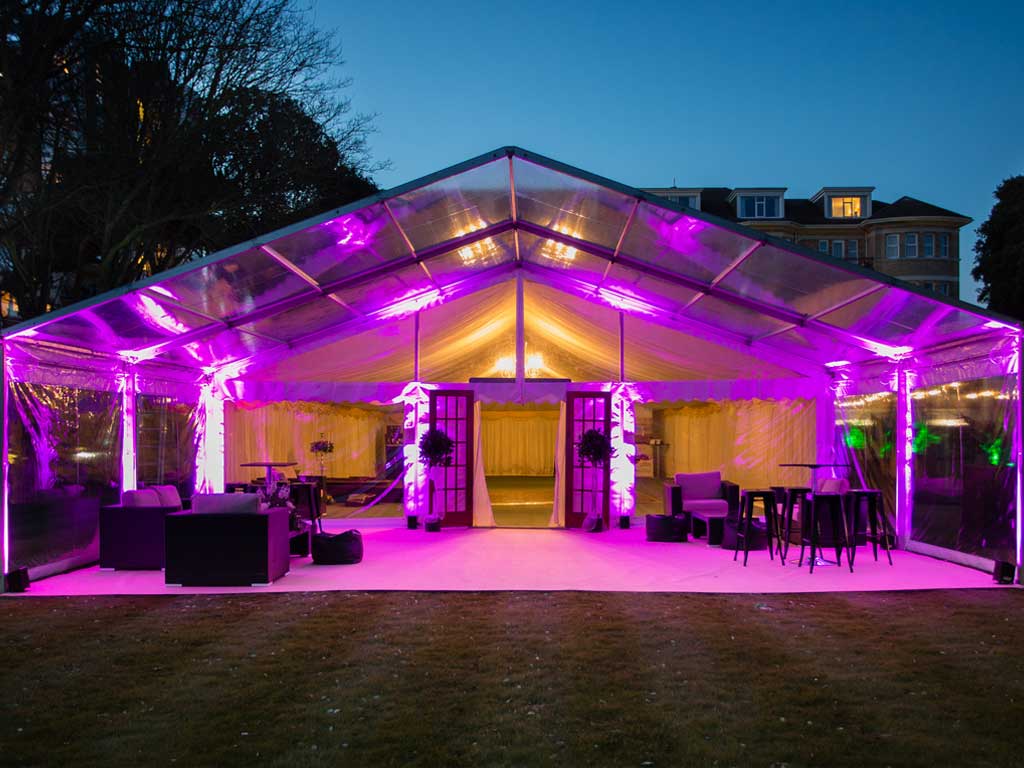
You may think this is going to be your main power draw but it likely isn’t. Although it will be the biggest space the power it consumes will be minimal.
In modern times everything all lighting is normally LED which draws a very small amount of power compared to the old school counterpart. For example a string of festoon lighting on old filament bulbs would of been in the region of 300 watts and now with LED replacements you are talking a total of 100 watts, and sometimes as low as 20 watts. That is nuts!
So the elements in the main marquee that use power are lighting, heating if you are having it and additional sockets for items that don’t include the band and bar. These are labelled separately as they warrant their own calculation.
If you haven’t done so already then it is a good idea to sketch out your space and draw in what and where electrical products are going. You can then create a check list and work out the power for each.
So in our example lets have some of our 20m strings of festoon lighting, these hold 20 bulbs each and each bulb is anywhere from 1w to 5w, so lets go with 5w to be conservative. 3 Strings should do the job = 300w.
Some LED uplighters for atmosphere. Our wired slimline units are 38w each and lets have 8 of those = 304w.
One of our indirect heating units are 370w and lets put 1 of those in. = 370w
This area can be power hungry and if there is one section worth doing properly, this is it. Don’t be scared to ask you catering company what their requirements for power is. They will likely say 4 sockets or something similar, but this isn’t adequate info. You want a list of electrical products they are bringing and the power required for each. If they can’t supply this then at the minimum you want a list because then you can go and make some educated guesses by doing your own research. Then add a bit extra on. Let us assume we have spoken to some caterers and have a list of the following items which between them and us we have allocated a power figure. On a side note, anything with a heating element (tea urn, fryer etc) will have a big draw. You can see the double fryer is huge on this.
It’s can be a good idea to ask them to use gas appliances where they can as this will keep the power draw down considerably. Also note that most of these are in KW. 1 KW is the same as 1000 W so make sure you read the correct number and unput it correctly when doing your own equation.
Bars can be very simply and some may not even require electric. For example if you have gin bar that is made up of a couple our old whiskey barrels and solid oak plank then the ingredients and glassware can be displayed on the top and maybe the only thing you might need it ice, which could be stored in a thermo box?
Alternatively you can have a complete bar setup as you would find in a pub, just on a smaller scale. This would mean a couple fo fridges, freezer for the ice, beer pump coolers and a till. All these items need power. In our example lets go to town.
In my experience, getting the actual figures in terms of KW from a band is tricky. The majority will just say 1 or 2 sockets is fine. The problem with this is they have a habit of just piling in a load of extension leads and splitting it off how they want. This is a common cause of the power tripping.
For this reason I always make sure that they have their own feed from the generator and that their power isn’t tied in with another element of the event. The generator, or distro board will have trip switches like you see in your house and in theory theirs alone should trip and they can’t blame anyone else.
For our generator calculation we shall put down 3 KW.
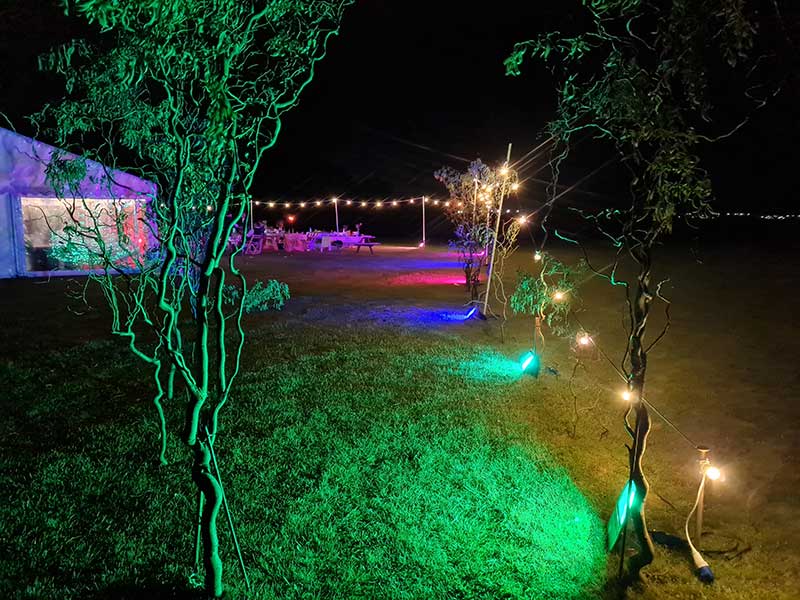
Typically all LED like inside the main marquee, this doesn’t cause to much concern. Festoon lighting and coloured uplighters are common place in this department and we have already spoken about the draws for these so for that reason i’m going to put 600W assuming we are going to town.
Chiller trailers and Luxury Toilet trailers run off a 16 amp lead so we know that at 230v the max output could be up to 3680 W. But they wont be running at the max so it’s safe ton assume lower and 3ooo W (or 3KW) is a safe assumption.
There will always be unknown items. It could be something small like staff members plugging in phone chargers, or bigger items that a caterer or band member forgot to include. Either way we would be wise to allow for something. In this case lets be super safe with 2 KW.
After working out all of the above we are looking at just shy of 40 KW for our wedding marquee power example. There are a few things we need to think about to turn this information into an accurate result for a generator size.
Firstly it is worth pointing out that not all of our power is going to be drawn at anyone time. This could result in us needing a generator big enough to run just half of this, but this would be very difficult to calculate. My main point here is if you find yourself tipping into the bracket of needing a generator the next size up because you are a couple of kilowatts over, then you will likely be fine to take the smaller one knowing this.
Another consideration is the power surge. When some appliances get turned on they surge in power at the start, therefore if multiple items where on the same circuit and surged at the same time this could cause tripping. To eliminate this, either split down the setup or have a buffer when doing the calculation. Personally I do both to be safe.
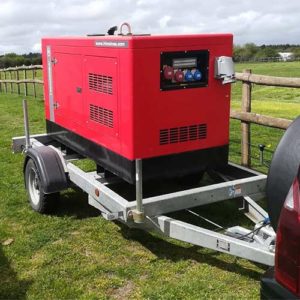
Next we need to convert our KW results into a KVA figure, which is how the generators are sized. For example our most popular generator we hire out for weddings is a 45 KVA – you can see that on our generator hire page here.
Simply multiply the KW by 0.8 for 3 phase generators, or by 1 for single phase generators. This will give you the KVA output.
Smaller generators will usually output single phase power, and larger generators will output 3 phase. Single phase has a power factor of 1 and 3 phase has a power factor of 0.8.
The size of a wedding generator will be on the larger size and it is safe to assume 3 phase.